

Kurdistan Regional Government
Representation in Italy
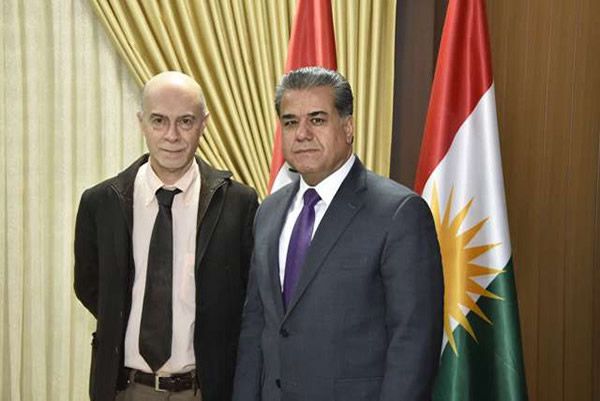

Rodolfo Casadei
Interview with the Minister of Foreign Affairs of Kurdistan Regional
Government. “Isis is not the danger that threatens Iraqi Kurdistan
but the economic crisis”
FROM OUR CORRESPONDENT IN KURDISTAN (IRAQ) - "Isis is not the danger that threatens Iraqi Kurdistan but the economic crisis." The Minister of Foreign Affairs of Kurdistan Regional Government (KRG) wants to impress the Italian correspondent with a paradox. Or maybe he means exactly what it says. In ten years, who heads the department that he himself created, Falah Mustafa Bakir was never found in hard times like these ones. In the past six months, the government has paid just one salary to its employees: employees, school and health personnel, workers of public works. If we consider peshmerga forces, we can say that in Iraqi Kurdistan civil servants are 400,000 for a population of 5 million inhabitants (not counting refugees and displaced people that moved to Iraqi Kurdistan in the last twelve or thirteen years). They cost more than $ 800 million per month, and for some time the administration can no longer afford this expense.
This occurred since the central government has stopped transferring 17 percent of the federal budget to the KRG in February 2014, but, above all, since the price of oil, the only real revenue of the region, has collapsed, passing within a few months from 110 to $ 30 a barrel. Earlier, in fact, the KRG made up for the missed federal transfers by increasing the autonomous exports of deposits on its territory (the independent Kurdish oil exports was the casus belli that prompted the then Prime Minister al-Maliki not to spill over the share agreed by the national budget).
Relations with Turkey are good, and this allows the Iraqi Kurds to
export their oil through the Turkish territory to the port of
Ceyhan, subject to Isis attacks and other more or less dark forces
against the pipeline that from Kirkuk reaches the Mediterranean sea.
But the sudden drop in oil prices has created a chasm in the public
accounts from 310 million to 320 million dollars a month. The
consequences are non-payment of salaries in the public sector (with
the partial exception of the peshmerga and hospital doctors, who
normally are not delayed by more than one or two months of wages),
the suspension of infrastructure projects financed by the regional
government (it is estimated that in 2015 alone there have been
suspended 6.000 projects), the collapse of the housing market, with
the collapse in prices of 300 per cent, and massive layoffs in the
private sector.
Karwan is a consultant for the department of foreign relations from
the business world: trade of agricultural and livestock products, he
also works at the Ministry not out of greed but to put together a
real salary, after the crisis has undermined its activity: "in
one year we have had to lay off two-thirds of the employees,
domestic consumption collapsed and the contracts with the Arab
regions were not renewed". Among the ranks of the KRG, double
work is not an exception, due to necessity, not out of greed: the
drivers make private guards in front of hotels and restaurants in
the evening, the employed are also shop assistants taking advantage
of part- time jobs. In Erbil the street protests are rare, but in
Suleymania and in other places there are strikes and roadblocks,
also animated by peshmerga furious at the delay of their salaries.
Ministers and general managers’ generous salaries have been cut by
40 percent to show their sensitivity towards those most affected by
the crisis. But the discontent is growing, and from social risks
becoming political. In Erbil the most visible face of the crisis is
represented by hundreds of construction sites that graying in the
work stagnation.
"If the economic crisis continues, even the military situation
will be affected negatively. If demotivation hit the ranks of our
fighters, we would lose the territories reconquered and would be at
risk everyone else, "says Falah Bakir. In reality, apart from
the town of Sinjar with the road leading to Syria and some village
of Telkeff district, north-west of Mosul, the peshmerga and its
allies have not regained other territories by the time of Daesh
offensive in August 2014. Although the Iraqi army has opened a front
near to Makhmour, south-west of Erbil, and despite the daily
skirmishes all along the north end of Mosul, the reconquest of the
great cities of the north seems really far to get, and that of the
Christian and yazide towns overlying Nineveh Plain seems to be a
dream that withers month after month, and that pushes out of Iraq's
borders tens of thousands of residents of those localities,
exasperated by life in the center for refugees. "We already
have the strength to reconquest all the Christian and yazide towns
of the Nineveh plain, but we don’t launch the offensive because,
without the simultaneous fall of Mosul, it would be an unnecessary
and bloody, a waste of human lives and military resources",
asserts the Minister. He gives his explanation: "Regaining
Bartellah, Bakshikah, Qaraqosh, Batnaya and Telkeff is not useless
at this time. We could not get people back there until Mosul is
under Isis hands: from there the jihadists can continuously make
raids on villages or bombard them with their artillery and mortars.
We are waiting for the Baghdad army and the international coalition
to deploy an important force to attack Mosul, then we can also do
our part. "
Falah Bakir expressed his gratitude for the military aid provided so
far, but not satisfaction: "We are grateful for Italy's
commitment in military cooperation with the forces of KRG, for the
advisers and instructors sent by Italian Government, and for
political relations created in the last two years with exchanges of
high-level institutional visits, but I cannot tell you that our
needs are greater than the response we have had so far. With weapons
and existing equipment, the peshmerga forces are exposed to high
risks. The Daesh attacks us with chemical weapons. We need to
protect ourselves from that equipment and other risks".
While fighting with Isis and faces an unprecedented economic crisis,
the Kurdish regional government has to manage the emergence of 1.8
million internally displaced persons and refugees from other
countries (especially Syria) who have found refuge on our territory,
and all together are equivalent to a third of the local population.
" the central government should provide them assistance, but
very little comes from Baghdad. We do what we can, but without the
participation of entities, such as the United Nations and
international NGOs, these people would be afflicted by hunger and
disease. In early exodus, the Kurds spontaneously helped these
people bringing food, mattresses and every possible help to the
displaced people. But now they have become poor themselves. In other
words, my appeal is as follows: 1.8 million refugees and displaced
persons in need of international aid as long as their lands are not
liberated from the occupation of Daesh. But there are also 5 million
Kurds who need international financial support if we do not want the
government to go bankrupt. If this happens, there will be
repercussions on the military capabilities of the peshmerga, and the
risk of losing the war against Daesh, just now that we can win it.
Originale Link : Tempi